
Steve Muck
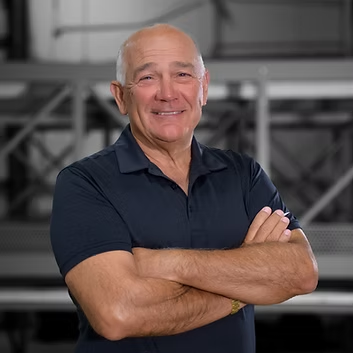
The Pittsburgh Robotics Network welcomes the addition of Stephen M. Muck, the Co-Founder & Executive Chairman of Advanced Construction Robotics, to the organization’s Board of Directors.
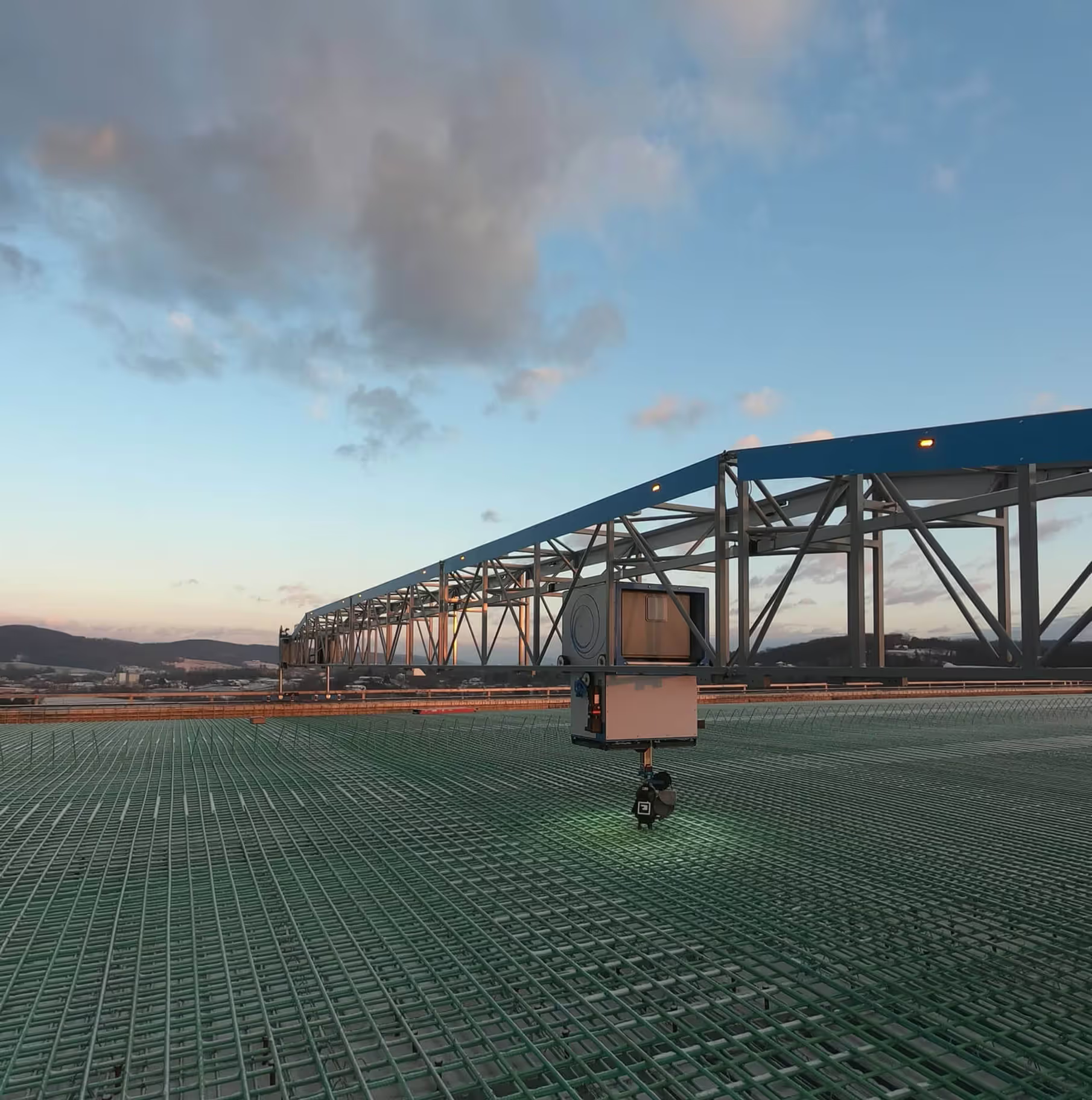
Muck, who also serves as chairman and CEO of Brayman Construction Corp. and a general partner at Grouse Ridge Capital, founded Advanced Construction Robotics (ACR) in 2016 alongside Jeremy Searock, formerly of Carnegie Mellon University’s National Robotics Engineering Center (NREC). ACR develops innovative robotics and artificial intelligence systems with the goal of enhancing productivity and improving safety at construction sites. Their first product was the autonomous rebar tying robot TyBOT, and they are currently in the late stages of development on the rebar placing robot IronBOT. The company is based in Pittsburgh, which is recognized as the Robotics Capital of the World.
The number of PRN directors grows to 19 with the addition of Muck, who adds his breadth of business and economic development expertise to a board already consisting of a broad set of stakeholders and leaders from industry, nonprofit and academia.
While the Pittsburgh Robotics Network is headquartered in Western Pennsylvania, the impact of the organization, as well as the influence of it’s Board, is felt beyond state lines and within the national and international robotics and machine learning communities. Among the distinguished stakeholders with seats on the PRN Board are representatives of autonomous vehicle pioneers Argo AI and Aurora; world-renowned research institutions such as Carnegie Mellon’s School of Computer Science and the University of Pittsburgh’s School of Computing and Information; robotics leaders such as KAARTA, RE2 and Seegrid; industry leaders such as Dentons and J.P. Morgan; and nationally leading seed-stage investor Innovation Works.
Led by veteran robotics industry executive Joel Reed, the PRN is a non-profit organization formed by regional industry leaders for the purpose of cluster creation and promotion to develop a network of highly engaged stakeholders that fosters business growth and jobs for a diverse pool of talent. The Pittsburgh Robotics Network’s board is committed to fulfilling the PRN vision of making the Pittsburgh robotics ecosystem the largest and most advanced in the world, and it currently features:
Kevin Dowling, CEO, Kaarta (President)
Jorgen Pedersen, Founder and CEO, RE2 (Secretary)
Parag Batavia, Founder, Neya Systems (Treasurer)
Marcel Bergerman, COO, Near Earth Autonomy
Matt Blackburn, Senior Manager, Government Relations, Aurora
Bruce Childers, Interim Dean, School of Computing and Information, University of Pittsburgh
Howie Choset, CMU & Co-Founder, HEBI Robotics
Mike Embrescia, Chief Development Officer, Carnegie Robotics
Martial Hebert, Dean, CMU School of Computer Science
David Kalson, National Group Leader, Dentons Venture Technology and Emerging Growth Companies Group
Zack Katic, Director of Strategic Talent, Argo AI
Afshan Khan, Portfolio Executive, Innovation Works
Justin Krauss, Executive Director, Technology & Disruptive Commerce, J.P. Morgan Commercial Banking
Louisa Michaels, Chief Financial Officer, The ARM Institute
Aaron Morris, Founder and CEO, Allvision
Stephen M. Muck, Co-Founder & Executive Chairman, Advanced Construction Robotics
Joel Reed, Executive Director, Pittsburgh Robotics Network
Jim Rock, CEO, Seegrid
Patti Rote, Program Manager, Robotics Institute; CMU & Co-Founder, Girls of Steel
Article courtesy of the Pittsburgh Robotics Network

Co-founders Jeremy Searock and Stephen Muck penned a letter to President Biden upon his visit to Pittsburgh to promote the Build Back Better Bill. Their message was clear. Construction has a labor shortage problem and robotic solutions can fill the gap to rebuild America’s infrastructure in a timely fashion.
Mr. President, Pittsburgh is the most important stop on your road trip to discuss the infrastructure bill.
That’s because without the work being done in Pittsburgh, the Build Back Better bill is still a dream. Construction simply does not have enough workers.
Our country is in the midst of a nationwide labor shortage. This is something the construction industry knows all too well. For several decades, the industry has faced a skilled labor shortage, one that is now approaching a crisis level. Some experts believe the U.S. needs more than 1 million construction workers just to handle work under development.
Now that the country plans to address its crumbling infrastructure, we need more than votes and workers — We need a “constructional revolution.” A revolution only made possible through the teaming of robotics and AI with skilled construction labor.
Luckily, that’s what’s happening here in Pittsburgh. We are proud to lead Advanced Construction Robotics, one of the many robotics companies in our region. This industry is pioneering solutions that will allow us to not only rebuild our infrastructure but also build a new economic sector.
Robotic solutions are not here to replace workers. They are here to fill the labor gap and provide safety, consistency, increased productivity, and build quicker. The trade unions agree. The younger generations love the idea of supervising a robot on the job site.
Robotics and AI can solve real world challenges like our labor shortage and infrastructure.
Mr. President, let’s get to work.
Mr. Searock and Mr. Muck's letter was included in the Pittsburgh Post Gazette Here.
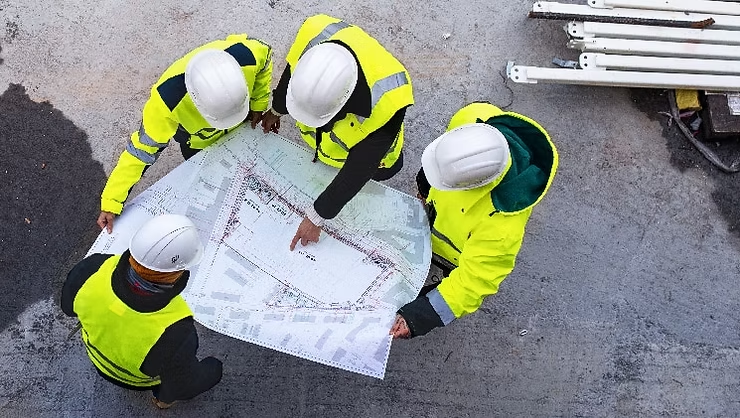
Stephen Muck our Co-Founder and Executive Chairman was recently featured on Liberty Mutual Insurance Construction Risk Round Table. Join us as we talk about how contractors are getting more done with less and saving money by using TyBOT® by Advanced Construction Robotics. Listen in to Episode 3 of the podcast below:
https://business.libertymutual.com/insights/construction-risk-roundtable/?extcmp=SUR_CN_tl_US_LINK
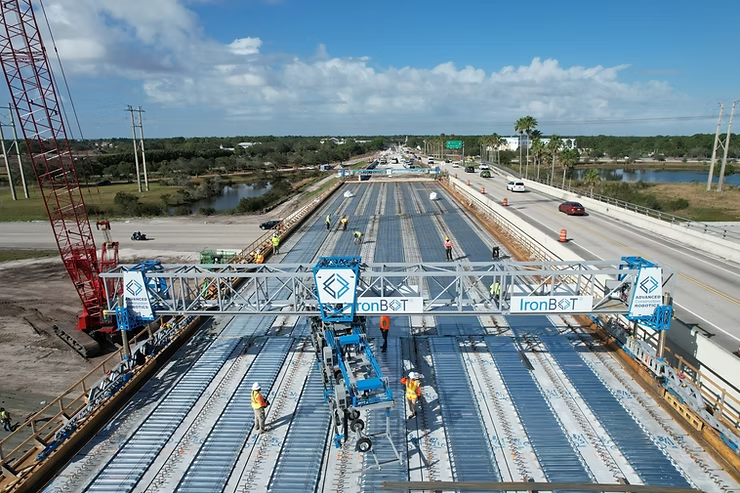
After the exciting release of IronBOT, Bridge Design & Engineering (BDE) featured both IronBOT and TyBOT in their magazine, 'The Smarter Twin.' ACR's Founder and Executive Chairman, Stephen Muck, talked to BDE about the BOTs and ACR's journey from the beginning.
“TyBOT is productive but not, by itself, disruptive. We believe combining TyBOT with IronBOT does generate a disruptive technology, meaning that the cost and time savings are so significant that it will disrupt the way the industry installs reinforcing steel,” says Stephen Muck.
Read the full article in Bridge Design & Engineering’s ‘The Smarter Twin’ (pg. 16-18):
Discover Our Rebar Robots
Explore how TyBot and IronBot can revolutionize your rebar installation process today.