
Company Announcements

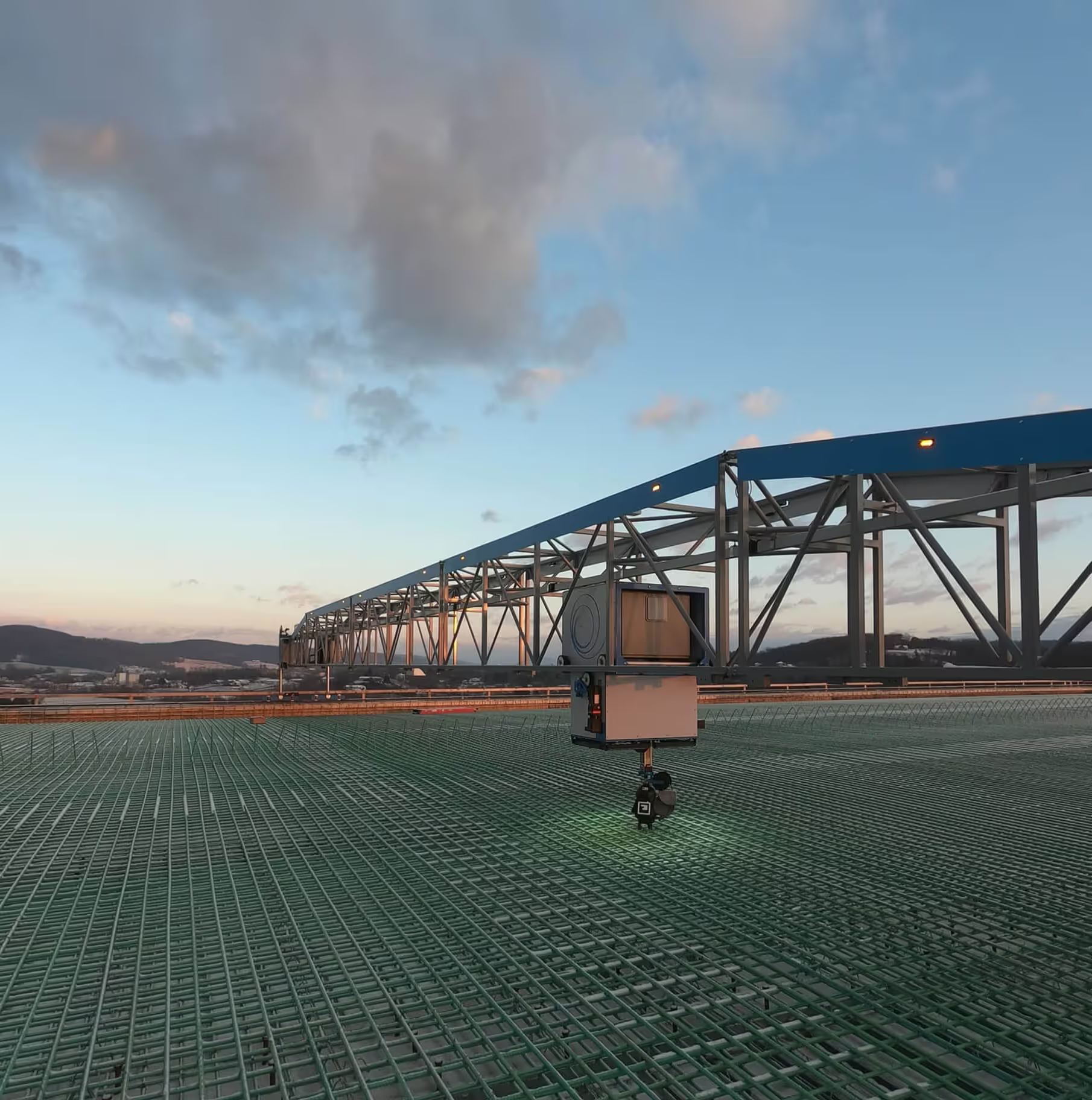
TyBOT’s cameras map out the rebar grid work area ahead and identify the intersections that need to be tied. The Tram independently positions the Tie Module over the next intersection, allowing the module to complete its assigned tie while TyBOT keeps track of the intersections it has completed. This cycle of mapping, positioning, tying and tracking efficiently continues until the entire work area has been completed and TyBOT notifies its Robot Supervisor before moving forward to continue operations.
TyBOT does all of this without Pre-Mapping, Pre-Programming or BIM Input.
It is just that simple! While TyBOT handles the backbreaking, repetitive task of bulk-tying your project’s rebar grid, your crew is free to move on to the project’s next critical path item.
Would you like to see TyBOT at your office or Jobsite? Schedule your Demo HERE.
2022 TyBOT Roadshow Schedule:
- Jan/Feb 2022: Nevada, Arizona, New Mexico, Texas, Oklahoma, Louisiana, Mississippi, Alabama, Georgia, North Carolina & South Carolina
- Spring 2022: Kentucky, Tennessee, Ohio, Virginia, West Virginia & Maryland
- Summer 2022: Illinois, Michigan, Wisconsin, Indiana, Minnesota & Iowa
If you are not located in one of the states that our team is currently scheduled to visit, we can arrange a fully interactive Virtual Demonstration from our Indoor Bridge Deck in Pittsburgh, PA and broadcast conveniently to you wherever you may be located.
Pittsburgh, Pennsylvania: The Construction industry has burst into a flurry of activity as the most aggressive infrastructure spending initiative since the 1950s was signed into law on Monday. Combined with a skilled labor shortage, the $550 Billion bill calls into question whether contractors have the capacity to meet rapidly growing demand. Innovative contractors across the nation are turning to new technology for help. Robots as a new class of equipment are proving to be an effective complement to human crews and will be essential to completing the projects laid out within the infrastructure bill.
Woman-owned Disadvantaged Business Enterprise Shelby Erectors is an example of the effective usage of robotics on the jobsite to contractors across the country. Contracted for rebar installation on the 512,427 sqft I-95 Express Phase 3C project in Ft. Lauderdale, Florida, Shelby elected to utilize TyBOT by Advanced Construction Robotics to boost crew productivity. TyBOT, a rebar tying robot, leverages cutting edge artificial intelligence to tie together the rebar grid that commonly reinforces concrete surfaces. While TyBOT is actively tying rebar, Shelby’s laborers are free to handle more skilled tasks better suited for human hands.
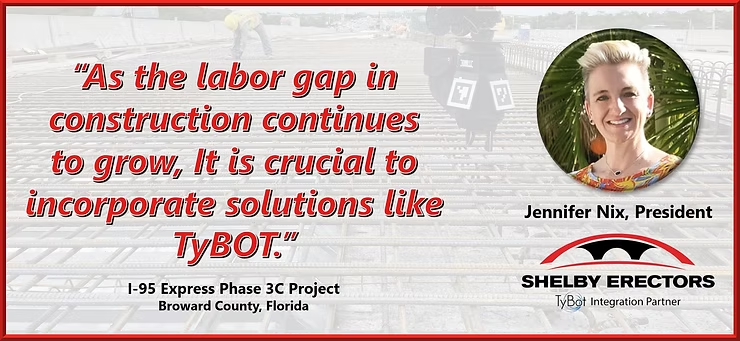
Shelby stands tall in the industry as an example of how to adapt to modern challenges, and its President, Jennifer Nix, is positioning her company to meet the labor demands of the new infrastructure bill. “TyBot is definitely a lifesaver when labor availability is lacking. It provides a level of consistency that's difficult to match and is why we’re currently using it on 3 separate concrete bridge construction projects across Florida.” Nix says, “TyBot removes the repetitive, back-breaking work that can cause serious long-term injuries, and anything we can do to improve our crews’ health and safety is a huge priority for us. TyBOT allows us to safely stay on schedule while shorthanded and to move our workforce on to higher-skilled tasks or to another jobsite where they can be better utilized.” The I-95 Express Project has become a landmark in the application of new technologies on major infrastructure projects. It is among the first projects in the world to address the labor shortage with cutting-edge robotic technology.
ACR is excited to call Shelby Erectors our integration partner. For many years our co-founders have observed the industry and have watched the labor gap growing. With this new infrastructure initiative, the shortage is accelerating at an alarming rate. Co-Founder Jeremy Searock is seeing his vision for the company become reality, saying “ACR was founded for moments like this. Our robots will continue to solve today’s construction challenges assisting the workforce to meet rapidly growing demand, such as what will be generated from the infrastructure bill.” ACR believes robotics can and will come to the rescue of crews struggling to close the growing labor gap. In order to complete the Billions in new projects, partnerships like those between Shelby and ACR will be absolutely essential.
Nix says “As the labor gap in construction continues to grow with increasing demand, it is crucial to incorporate solutions like TyBot to mitigate the effects. We have found that TyBOT saves at least 25% on our rebar tying schedule. This provides a crucial edge when bidding projects, and project owners, typically DOT, often like to see innovative tech used. We will likely use TyBot on over half of our projects in the next 5 years.” The effectiveness of jobsite robotics on this project will be sure to be noticed as contractors scramble to address the flood of new infrastructure initiatives coming from Capitol Hill. The lesson is clear, useful robots are no longer science fiction. They are here and ready to do work today.
-------------------------------------------------------------------------------------------------
A world-leading innovator of autonomous robotic equipment, Advanced Construction Robotics is transforming the construction industry by filling the skilled labor gap and increasing overall productivity. Our robots give construction firms the ability to meet a rapidly growing demand, improve safety, and reduces scheduling risks. TyBOT, ACR’s first product, is a rebar tying robot that self-navigates, self-ties, and does not require programming or build plan input from the working crew. TyBot’s partner, IronBot, will lift, carry, and install rebar when it comes to market in 2022.

Co-founders Jeremy Searock and Stephen Muck penned a letter to President Biden upon his visit to Pittsburgh to promote the Build Back Better Bill. Their message was clear. Construction has a labor shortage problem and robotic solutions can fill the gap to rebuild America’s infrastructure in a timely fashion.
Mr. President, Pittsburgh is the most important stop on your road trip to discuss the infrastructure bill.
That’s because without the work being done in Pittsburgh, the Build Back Better bill is still a dream. Construction simply does not have enough workers.
Our country is in the midst of a nationwide labor shortage. This is something the construction industry knows all too well. For several decades, the industry has faced a skilled labor shortage, one that is now approaching a crisis level. Some experts believe the U.S. needs more than 1 million construction workers just to handle work under development.
Now that the country plans to address its crumbling infrastructure, we need more than votes and workers — We need a “constructional revolution.” A revolution only made possible through the teaming of robotics and AI with skilled construction labor.
Luckily, that’s what’s happening here in Pittsburgh. We are proud to lead Advanced Construction Robotics, one of the many robotics companies in our region. This industry is pioneering solutions that will allow us to not only rebuild our infrastructure but also build a new economic sector.
Robotic solutions are not here to replace workers. They are here to fill the labor gap and provide safety, consistency, increased productivity, and build quicker. The trade unions agree. The younger generations love the idea of supervising a robot on the job site.
Robotics and AI can solve real world challenges like our labor shortage and infrastructure.
Mr. President, let’s get to work.
Mr. Searock and Mr. Muck's letter was included in the Pittsburgh Post Gazette Here.
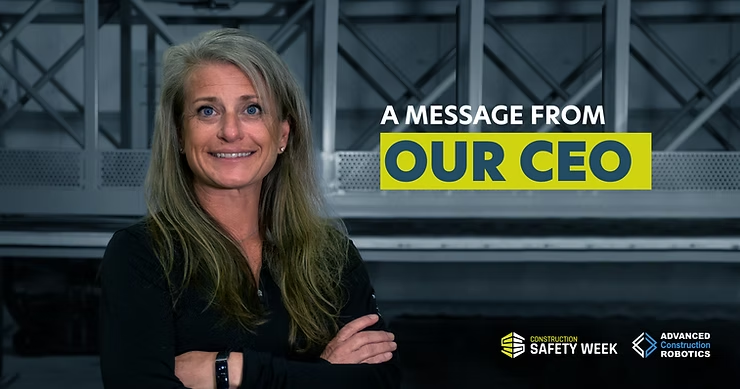
Hello everyone I am Danielle Proctor, CEO of Advanced Construction Robotics here to close out safety week by renewing our commitment as a company to improve safety on jobsites through technology. As we reflect on the past week and all of the amazing safety initiatives across the construction industry we are inspired to continue to innovate for the sake of worker health. We believe that human laborers on the job site are a contractor's most valuable asset, and as such, every measure should be taken to protect them. There is no greater method of improving safety than to remove workers from dangerous situations entirely. We at ACR encourage all contractors to take a look at the automation of dangerous and injury-prone tasks in order to keep their crews safer.
Of course, automation is not the only modern method of safety improvement. New technologies are emerging every day for improving safety on the jobsite, whether it be through wearables, software, or more. The robotics renaissance we are currently experiencing will lead to leaps forward in safety. We encourage anyone in construction and beyond to open their minds to modern safety solutions. We want to say thank you to all of the safety professionals out there today working to keep crews safe and healthy. Your work is invaluable not just during safety week, but every week. Stay safe out there everyone, and remember to keep innovating infrastructure.
Advanced Construction Robotics is a leading innovator of autonomous robotic construction equipment. The organization is built on four pillars, improving safety, enhancing productivity, increasing consistency, and reducing schedule risks. Every day the ACR team strives to bring these benefits to real contractors on real job sites. Learn more about ACRs pillars here.
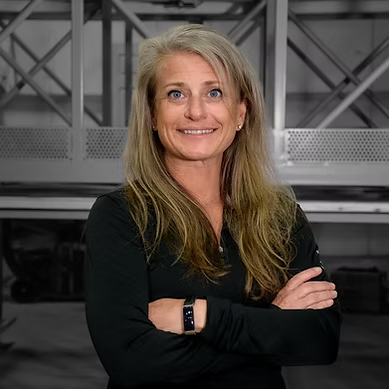
Pittsburgh, Pennsylvania –Danielle Proctor, CEO of Advanced Construction Robotics, has been appointed to the Regional Industrial Development Corporation (RIDC) Board of Directors. Proctor brings 25 years of construction, software, technology, new product development and leadership experience to the boardroom as RIDC continues to play a leadership role in the region’s economic development and in developing properties that provide homes for companies that are driving Pittsburgh’s innovation economy.
A graduate of Carnegie Mellon University, Proctor began her career at Management Science Associates, involved with the product and business development of an automated business intelligence systems. She then joined FreeMarkets, later acquired by Ariba, as part of the product management team that designed and launched the software interface for their auction-based supply-chain management service. She founded Amelie Construction & Supply, a certified Woman/Disadvantaged Business Enterprise (W/DBE) construction firm providing construction services throughout the eastern region where she served as President & CEO for 12 years until selling her ownership in 2015. Proctor continued to pursue her passion of being involved with start-ups by founding and acquiring several smaller ventures as well as providing private funding and consulting to companies during their critical formation stages. Proctor joined the Advanced Construction Robotics team in 2020 as Director of Business Development. In May of 2021, she was named Chief Executive Officer. Danielle now directs business strategy and operations, making ACR’s robots a commercial reality in the field.
RIDC President Don Smith, Jr. called Proctor “a dynamic leader whose company is demonstrating how autonomous technology is having a transformative effect on a wide array of industries, making job sites safer and more efficient. Her perspective on the deployment of new technologies in construction and on the needs of growing tech companies generally will be extremely valuable as RIDC moves forward.”
RIDC catalyzes and supports economic growth through leadership on policy initiatives, high quality job creation, real estate development and financing of projects that advance the public interest – developing real estate to capture emerging and existing growth opportunities across diverse industry sectors. As tech continues to grow in the region, RIDC will remain at the forefront of the effort, developing key properties for the industry to grow in and continuing its advocacy for public policy that facilitates that growth.
“I am excited to join the board of RIDC at such an exciting and pivotal time for Pittsburgh’s tech environment. The landscape of Pittsburgh is changing rapidly and the team and RIDC is leading the way. I cannot wait to see the innovative and impactful solutions that the future will bring.” – Danielle Proctor, CEO, Advanced Construction Robotics
###
ABOUT ADVANCED CONSTRUCTION ROBOTICS
A leading provider of robotic equipment, ACR is transforming the construction industry by filling the skilled labor gap and increasing overall productivity. Our robots give construction firms the ability to consistently meet growing demand, reduce scheduling risks and improve safety. TyBOT®, ACR’s first product, is a rebar tying robot that self-navigates, self-ties, and does not require programming or BIM plan input from the working crew. TyBOT’s partner, IronBOT, will lift, carry, and install rebar when it comes to market in 2022.
PRESS CONTACT:
Name: Bryce Nelson
Phone: 412-756-3360 x50478
Discover Our Rebar Robots
Explore how TyBot and IronBot can revolutionize your rebar installation process today.