News & Podcasts
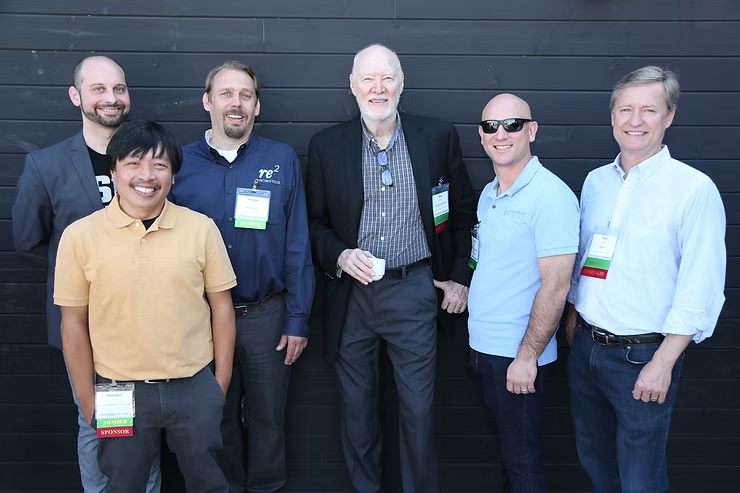
ACR Co-Founders Stephen Muck and Jeremy Searock, along with LB Construction Enterprises president LaMar Childs, joined the Pittsburgh Robotics Network to discuss the exciting transformation robotics is bringing to construction. Childs provided unique industry insight as a real-world user of ACR’s TyBot.
You can watch the discussion below:

The Pittsburgh Robotics Network welcomes the addition of Stephen M. Muck, the Co-Founder & Executive Chairman of Advanced Construction Robotics, to the organization’s Board of Directors.
Muck, who also serves as chairman and CEO of Brayman Construction Corp. and a general partner at Grouse Ridge Capital, founded Advanced Construction Robotics (ACR) in 2016 alongside Jeremy Searock, formerly of Carnegie Mellon University’s National Robotics Engineering Center (NREC). ACR develops innovative robotics and artificial intelligence systems with the goal of enhancing productivity and improving safety at construction sites. Their first product was the autonomous rebar tying robot TyBOT, and they are currently in the late stages of development on the rebar placing robot IronBOT. The company is based in Pittsburgh, which is recognized as the Robotics Capital of the World.
The number of PRN directors grows to 19 with the addition of Muck, who adds his breadth of business and economic development expertise to a board already consisting of a broad set of stakeholders and leaders from industry, nonprofit and academia.
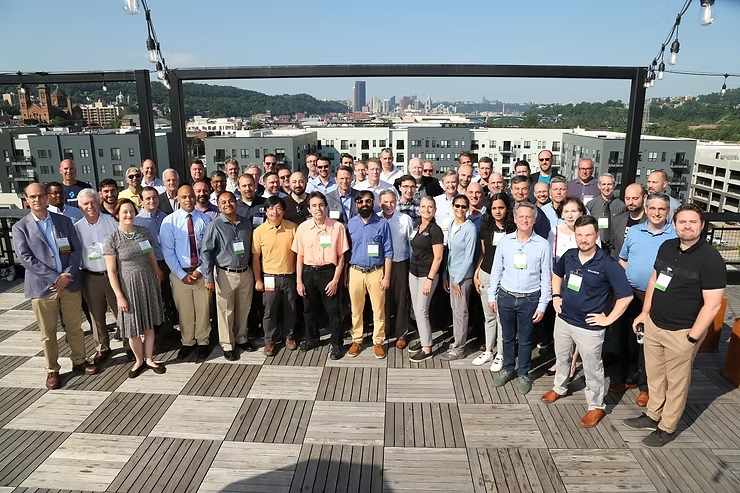
While the Pittsburgh Robotics Network is headquartered in Western Pennsylvania, the impact of the organization, as well as the influence of it’s Board, is felt beyond state lines and within the national and international robotics and machine learning communities. Among the distinguished stakeholders with seats on the PRN Board are representatives of autonomous vehicle pioneers Argo AI and Aurora; world-renowned research institutions such as Carnegie Mellon’s School of Computer Science and the University of Pittsburgh’s School of Computing and Information; robotics leaders such as KAARTA, RE2 and Seegrid; industry leaders such as Dentons and J.P. Morgan; and nationally leading seed-stage investor Innovation Works.
Led by veteran robotics industry executive Joel Reed, the PRN is a non-profit organization formed by regional industry leaders for the purpose of cluster creation and promotion to develop a network of highly engaged stakeholders that fosters business growth and jobs for a diverse pool of talent. The Pittsburgh Robotics Network’s board is committed to fulfilling the PRN vision of making the Pittsburgh robotics ecosystem the largest and most advanced in the world, and it currently features:
Kevin Dowling, CEO, Kaarta (President)
Jorgen Pedersen, Founder and CEO, RE2 (Secretary)
Parag Batavia, Founder, Neya Systems (Treasurer)
Marcel Bergerman, COO, Near Earth Autonomy
Matt Blackburn, Senior Manager, Government Relations, Aurora
Bruce Childers, Interim Dean, School of Computing and Information, University of Pittsburgh
Howie Choset, CMU & Co-Founder, HEBI Robotics
Mike Embrescia, Chief Development Officer, Carnegie Robotics
Martial Hebert, Dean, CMU School of Computer Science
David Kalson, National Group Leader, Dentons Venture Technology and Emerging Growth Companies Group
Zack Katic, Director of Strategic Talent, Argo AI
Afshan Khan, Portfolio Executive, Innovation Works
Justin Krauss, Executive Director, Technology & Disruptive Commerce, J.P. Morgan Commercial Banking
Louisa Michaels, Chief Financial Officer, The ARM Institute
Aaron Morris, Founder and CEO, Allvision
Stephen M. Muck, Co-Founder & Executive Chairman, Advanced Construction Robotics
Joel Reed, Executive Director, Pittsburgh Robotics Network
Jim Rock, CEO, Seegrid
Patti Rote, Program Manager, Robotics Institute; CMU & Co-Founder, Girls of Steel
Article courtesy of the Pittsburgh Robotics Network
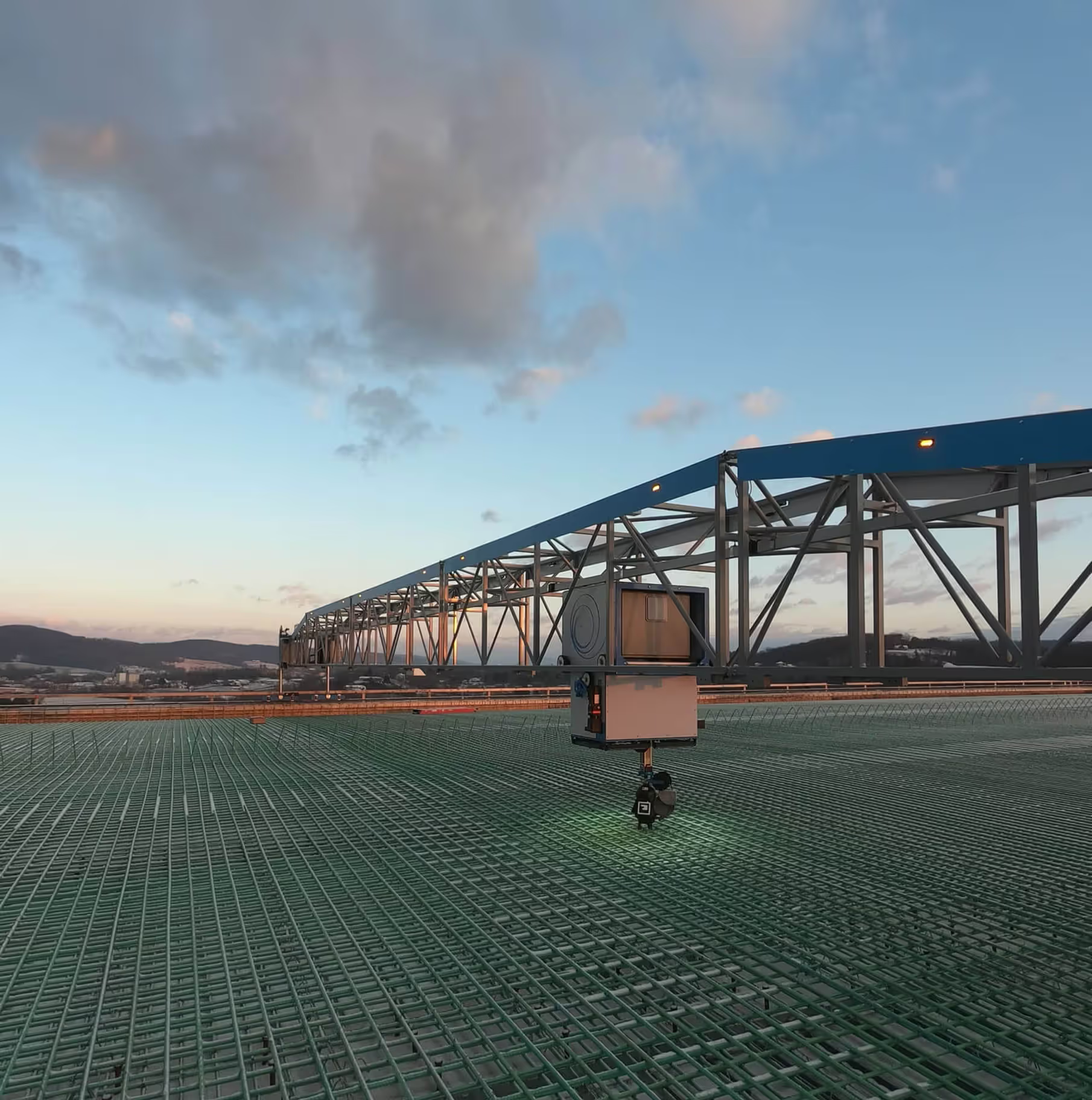
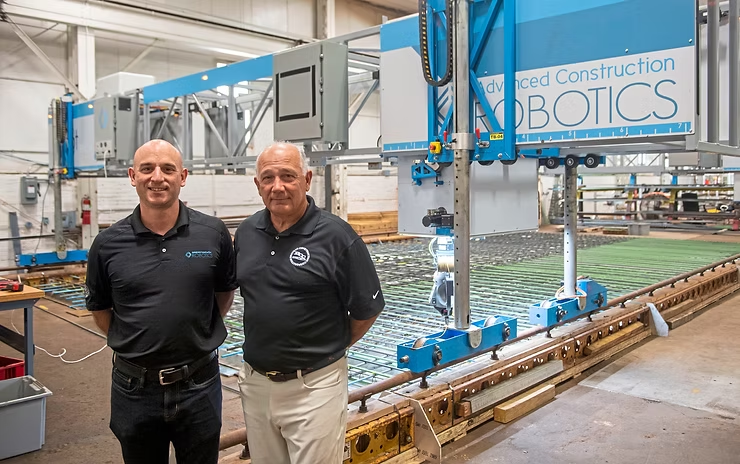
TyBOT’s cameras map out the rebar grid work area ahead and identify the intersections that need to be tied. The Tram independently positions the Tie Module over the next intersection, allowing the module to complete its assigned tie while TyBOT keeps track of the intersections it has completed. This cycle of mapping, positioning, tying and tracking efficiently continues until the entire work area has been completed and TyBOT notifies its Robot Supervisor before moving forward to continue operations.
TyBOT does all of this without Pre-Mapping, Pre-Programming or BIM Input.
It is just that simple! While TyBOT handles the backbreaking, repetitive task of bulk-tying your project’s rebar grid, your crew is free to move on to the project’s next critical path item.
Would you like to see TyBOT at your office or Jobsite? Schedule your Demo HERE.
2022 TyBOT Roadshow Schedule:
- Jan/Feb 2022: Nevada, Arizona, New Mexico, Texas, Oklahoma, Louisiana, Mississippi, Alabama, Georgia, North Carolina & South Carolina
- Spring 2022: Kentucky, Tennessee, Ohio, Virginia, West Virginia & Maryland
- Summer 2022: Illinois, Michigan, Wisconsin, Indiana, Minnesota & Iowa
If you are not located in one of the states that our team is currently scheduled to visit, we can arrange a fully interactive Virtual Demonstration from our Indoor Bridge Deck in Pittsburgh, PA and broadcast conveniently to you wherever you may be located.

Pittsburgh, Pennsylvania: The Construction industry has burst into a flurry of activity as the most aggressive infrastructure spending initiative since the 1950s was signed into law on Monday. Combined with a skilled labor shortage, the $550 Billion bill calls into question whether contractors have the capacity to meet rapidly growing demand. Innovative contractors across the nation are turning to new technology for help. Robots as a new class of equipment are proving to be an effective complement to human crews and will be essential to completing the projects laid out within the infrastructure bill.
Woman-owned Disadvantaged Business Enterprise Shelby Erectors is an example of the effective usage of robotics on the jobsite to contractors across the country. Contracted for rebar installation on the 512,427 sqft I-95 Express Phase 3C project in Ft. Lauderdale, Florida, Shelby elected to utilize TyBOT by Advanced Construction Robotics to boost crew productivity. TyBOT, a rebar tying robot, leverages cutting edge artificial intelligence to tie together the rebar grid that commonly reinforces concrete surfaces. While TyBOT is actively tying rebar, Shelby’s laborers are free to handle more skilled tasks better suited for human hands.
Shelby stands tall in the industry as an example of how to adapt to modern challenges, and its President, Jennifer Nix, is positioning her company to meet the labor demands of the new infrastructure bill. “TyBot is definitely a lifesaver when labor availability is lacking. It provides a level of consistency that's difficult to match and is why we’re currently using it on 3 separate concrete bridge construction projects across Florida.” Nix says, “TyBot removes the repetitive, back-breaking work that can cause serious long-term injuries, and anything we can do to improve our crews’ health and safety is a huge priority for us. TyBOT allows us to safely stay on schedule while shorthanded and to move our workforce on to higher-skilled tasks or to another jobsite where they can be better utilized.” The I-95 Express Project has become a landmark in the application of new technologies on major infrastructure projects. It is among the first projects in the world to address the labor shortage with cutting-edge robotic technology.
ACR is excited to call Shelby Erectors our integration partner. For many years our co-founders have observed the industry and have watched the labor gap growing. With this new infrastructure initiative, the shortage is accelerating at an alarming rate. Co-Founder Jeremy Searock is seeing his vision for the company become reality, saying “ACR was founded for moments like this. Our robots will continue to solve today’s construction challenges assisting the workforce to meet rapidly growing demand, such as what will be generated from the infrastructure bill.” ACR believes robotics can and will come to the rescue of crews struggling to close the growing labor gap. In order to complete the Billions in new projects, partnerships like those between Shelby and ACR will be absolutely essential.
Nix says “As the labor gap in construction continues to grow with increasing demand, it is crucial to incorporate solutions like TyBot to mitigate the effects. We have found that TyBOT saves at least 25% on our rebar tying schedule. This provides a crucial edge when bidding projects, and project owners, typically DOT, often like to see innovative tech used. We will likely use TyBot on over half of our projects in the next 5 years.” The effectiveness of jobsite robotics on this project will be sure to be noticed as contractors scramble to address the flood of new infrastructure initiatives coming from Capitol Hill. The lesson is clear, useful robots are no longer science fiction. They are here and ready to do work today.
-------------------------------------------------------------------------------------------------
A world-leading innovator of autonomous robotic equipment, Advanced Construction Robotics is transforming the construction industry by filling the skilled labor gap and increasing overall productivity. Our robots give construction firms the ability to meet a rapidly growing demand, improve safety, and reduces scheduling risks. TyBOT, ACR’s first product, is a rebar tying robot that self-navigates, self-ties, and does not require programming or build plan input from the working crew. TyBot’s partner, IronBot, will lift, carry, and install rebar when it comes to market in 2022.

Our CEO, Danielle Proctor, had a discussion last week with Regional Industrial Development Corporation’s, President Don Smith and Matthew Johnson-Roberson, director of Carnegie Mellon University’s Robotics Institute about Pittsburgh’s autonomous ‘renaissance’. Read the article and watch the video below to learn more about transitions from R&D to commercialization and manufacturing, creating jobs and other future growth opportunities.
Discover Our Rebar Robots
Explore how TyBot and IronBot can revolutionize your rebar installation process today.